
This article discusses what Nitinol is, why machining and cutting Nitinol is so difficult, and why micro abrasive waterjet cutting is the preferred method for cutting it.
If you need a material with high biocompatibility, superelastic properties, or the ability to “remember” and revert to a specific shape, you are probably considering using Nitinol. This amazing material can be used for a number of unique applications thanks to its peculiar material properties.
While these special characteristics make Nitinol an invaluable material, they are also part of the reason Nitinol cutting and machining is so challenging.
What is Nitinol (Nickel Titanium)?
In the following we have provided a brief explanation on why Waterjet Cutting Nitinol is ideal for cutting nitinol, and provides the highest level of production capabilities, precision, cutting speed, and surface quality in one single pass.
Nitinol –
Nickel-Titanium alloy discovered at the Naval Ordnance Laboratory
Nitinol’s superelasticity, or pseudoelasticity, means that it can be stretched past the limits of other metals that would permanently deform or break under similar conditions. This means it can be used for applications like orthodontic wires in dentistry, that continuously shrink after placement so that they don’t need to be readjusted. Or they can be used in civil engineering applications to make damping or “self-healing” concrete structures.
Shape memory alloy
The ability of Nitinol products to remember their original shape means they can shrink if stretched and then reheated, applying tension as it shrinks. But it also allows for other complex applications. As a shape memory alloy, Nitinol alloys can be bent, twisted, and stretched, then returned to its desired shape with moderate heating. Even the heat produced from a human body is enough to trigger the shape memory effect (SME). Along with its high corrosion resistance and biocompatibility, this makes Nitinol an excellent material for medical devices like nitinol stents.
Why is nitinol hard to machine?
While Nitinol offers some excellent product capabilities, it is also a very difficult-to-machine alloy for two main reasons. First off, Nitinol is a very hard material because of the titanium oxide layer that forms on its surface. The high hardness means large cutting forces are needed to deform or remove material, and mechanical tools used for cutting quickly become dull and worn. If you need to cut tiny Nitinol with shear-type cutters, or if you need to machine larger Nitinol workpieces with a CNC lathe or milling machine, expect high tool wear and frequent tool replacement.
Managing heat input
The second major challenge of machining or cutting Nitinol is managing heat input during processing. Because of its properties as an SMA, Nitinol is sensitive to these thermal stresses, which can damage its ability to achieve the shape memory effect. Any thermal cutting process, like laser cutting or Wire EDM, introduces a heat-affected zone (HAZ) adjacent to the cut area, part of which has been heated above the maximum allowable temperature for the Nitinol to retain its abilities as an SMA. For parts cut using thermal processes like laser, the HAZ may need to be removed by other non-thermal machining methods after initial cutting.
Avoiding material distortion
For small features, there is a risk that thermally-based cutting can affect Nitinol’s shape memory properties through the part’s thickness. On the flip side, cutting thicker parts with laser cutting means slower cutting speeds and higher heat input in a localized area. Turning and milling generate significant heat and cause material distortion. Wire EDM provides slightly better results than turning and milling, but far from the quality that femtosecond laser and micro abrasive waterjet can deliver.
Overall, managing heat input is one key area where cold cutting methods like micro abrasive waterjet cutting have a distinct advantage. This makes cutting nitinol more efficient, easier to do, and more cost-effective when using micro abrasive waterjet.
Precision cutting nitinol with micro abrasive waterjet
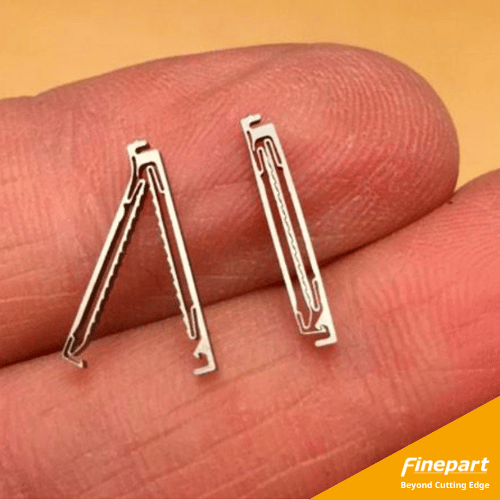
In this video you will see how a Finepart micro abrasive waterjet cuts nitinol surgery clips without any need for a second finish, all in one cutting process
The Finepart micro waterjets is a cold cutting process that provides exceptional high precision cutting capabilities of complex shapes, optimum cut quality, high cutting speeds, and low production costs.
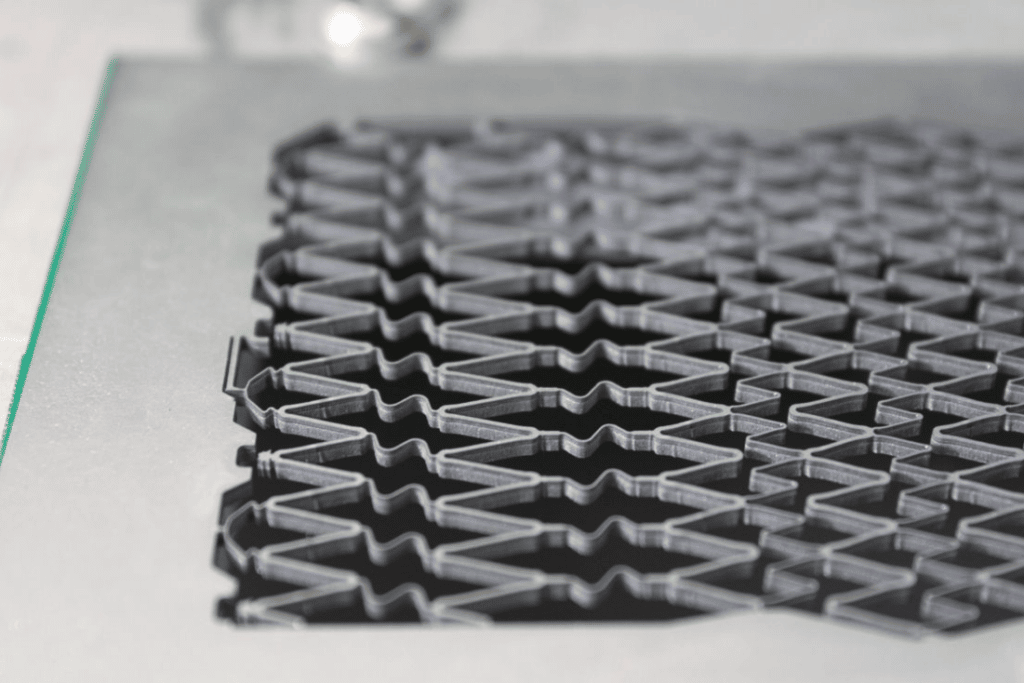
Nitinol is an advanced material regularly used for unique parts and intricate designs, like medical stents. Micro abrasive waterjet machines from Finepart are built for precision. With a positional accuracy of no more than ±2.5 microns and the ability to cut within a ±10 micron tolerance, Finepart micro abrasive waterjet machines are over 10 times more accurate than a traditional waterjet.
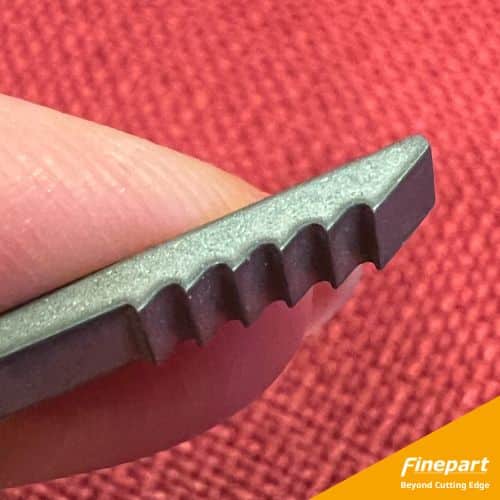
Whether it’s for medical components that require smooth surfaces or parts under stress that must be free from microcracks, Finepart micro abrasive waterjets produce great results. Finepart machines do not generate burrs, oxides, or heavy slag as a result of the cutting. And in hard materials like nitinol, Finepart machines can even achieve roughness values down to 0.8 µm (Ra).
Unlike traditional abrasive waterjets that embed abrasive particles into the material’s surface and cut tapered edges, Finepart micro abrasive waterjets result in exceptionally smooth edges and cut surfaces.
Cutting methods that generate heat, like milling and laser, often causes micro cracks in the material. Micro cracks on the cut surface are undesirable as they highly increase the risk for breakage in the material. Micro abrasive cutting is cold and do not cause any micro cracks.
When it comes to cutting or machining nitinol, cutting speed has a significant influence on edge and surface quality. Finepart micro abrasive waterjets can maintain exceptional accuracy and a smooth surface while cutting several times faster than many alternative methods, like wire EDM or waterjet-guided laser. When cutting nitinol, like nitinol stents, Finepart machines can cut between 182 mm/min (7.2″/min) and 469 mm/min (18.5″/min) depending on the feature being cut.
In order to cut extremely fine features for small nitinol parts, producers must rely on methods like wire EDM, laser cutting, or micro abrasive waterjet cutting. The tooling from mechanical machining methods like turning and machining simply cannot match the narrow kerf width achievable through the non-contact processes.
The waterjet kerf width that can be achieved using Finepart machines is between 0.2 – 0.5mm. (0.008″ – 0.02″)
As discussed previously, nitinol is highly susceptible to thermal damage, which can prevent it from performing the shape memory effect as intended and can even distort the material so that it no longer meets quality tolerances. Waterjet is a cold cutting technology, which eliminates the risk of thermally stressing the nitinol or creating heat-affected zones.
The exceptional hardness of nitinol causes rapid tool wear when cutting or machining it with equipment like a CNC milling machine or lathe. Tooling costs are much lower when using non-contact machining methods like laser and micro abrasive waterjet.
Finepart micro abrasive waterjet machines can accommodate a wide range of material sizes for all your cutting needs that fit within the dimensions of the work envelope 500 x 500mm (19.69″ x 19.69″).
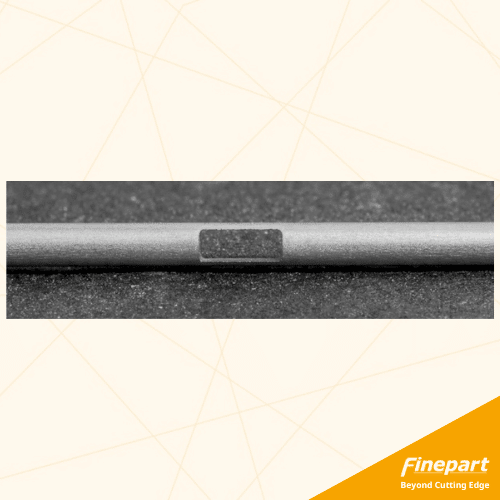
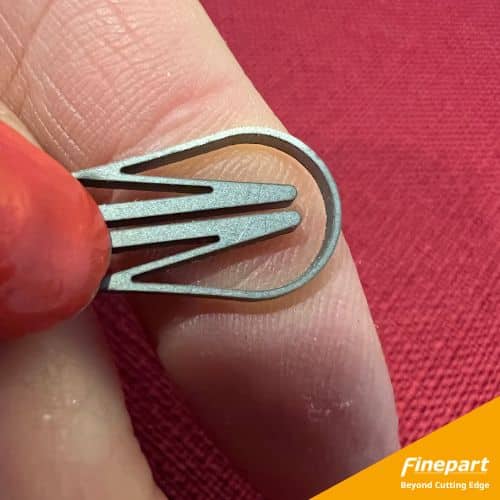
Examples of Micro Waterjet Cutting Nitinol
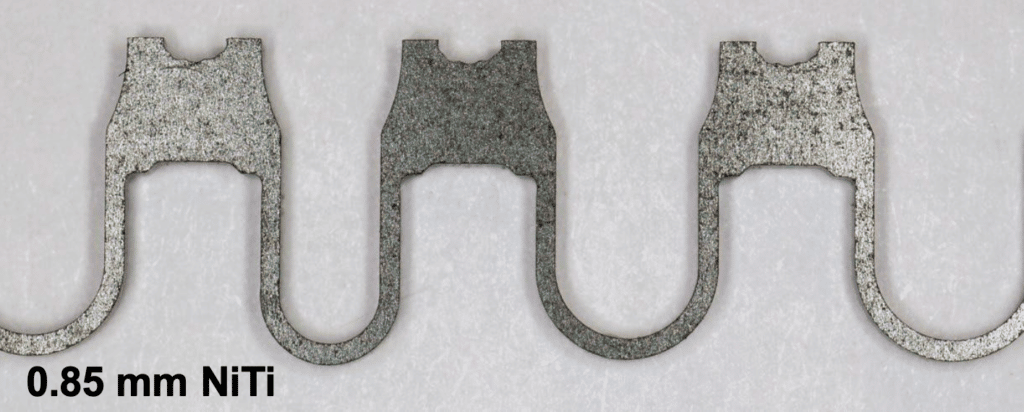
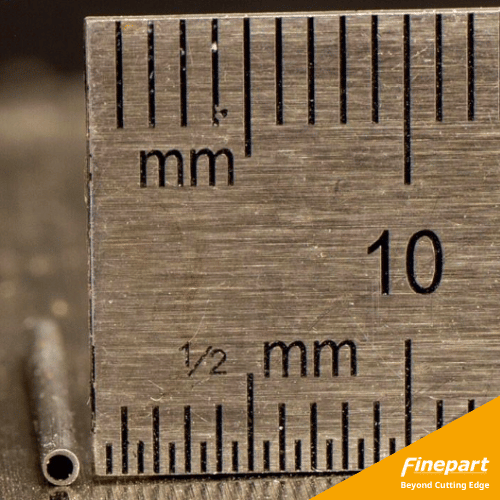
What is nitinol used for?
Nitinol has been around since the early 1960s but was unavailable commercially until twenty years later due to the tight controls needed in the manufacturing process. Since then, it has become an important material for robotics and in the medical industry for various medical applications, like medical devices. Nitinol is superelastic (10X as flexible as other metals), and its thermal shape memory properties are unlike any other material available.
Nitinol Applications: Medical Devices
- Dentistry, especially in orthodontics for wires and brackets that connect the teeth.
- Endodontics, mainly during root canals for cleaning and shaping root canals.
- In colorectal surgery, the material is used in various devices for reconnecting the intestine after a pathology is removed.
- Nitinol Stents
- Surgical implants and surgical instruments
- Orthopedic implants.
- Medical guidewires
- Nitinol screws
- Nitinol wire
- Nitinol stent
- Nitinol tube
- Surgical implant
Other industries and applications that utilize nitinol parts include:
- Frames for glasses
- Cell phone components
- Temperature controls
- Mechanical watch springs
- Energy/power related applications
- And many more!
Choosing the Best Micro Waterjet For Your Needs
To find out which micro waterjet machines will fit your requirements best, you should make your decision based on the following factors:
Water pressure is a critical factor for determining a waterjet machine’s capabilities. Being able to achieve higher water pressures and maintain a smooth pressure profile translates into more penetrative ability, for processing thicker materials, and faster cutting speeds, which reduces production costs and increases productivity. The Finepart intensifier pump will provide you with ample water pressure to cut any material thickness up to 20 mm. (0.8″) and beyond.
Finepart offers an assortment of options for upgrading your Finepart micro abrasive waterjet machines, from a high-frequency spindle addon for drilling and milling to 5-axis manipulators for added cutting versatility. You can add any of these upgrades to our waterjet cutting machines so that you can customize the cutting equipment to meet your unique needs and specifications.
You can also choose between cutting system in different sizes, which are capable of cutting narrow intricate geometries as well as thicker material at higher speed.
All Finepart micro waterjet cutters come with design software that you can operate on a computer and a complete computerized waterjet software and operating panel. This software is highly intuitive, without the need for CNC waterjet coding experience, and helps you to cut high quality parts without the need for manual intervention.
Your cutting needs will determine the versatility you need from your waterjet machine. Finepart offers 3 axis, 4 axis, and 5-axis micro waterjet machines to meet the needs of all our customers, whether you need to cut simple 2D shapes or complex 3D parts. There is always a Finepart machine that fits your specific needs.
When considering all critical factors, Finepart micro abrasive waterjet cutters provide you with cutting-edge solution to satisfy any of your micro cutting needs.
Finepart micro abrasive waterjet machines have all the features you need for 2D and 3D cutting of parts thinner than 20 mm. (0.8″). Plus, you can add any of our options to upgrade any waterjet machine to achieve top specifications, which means you can easily find a Finepart machine to fit your budget and production needs.
For more info on Finepart’s micro abrasive waterjet machines:
3 axis waterjet
4 axis waterjet
5 axis waterjet
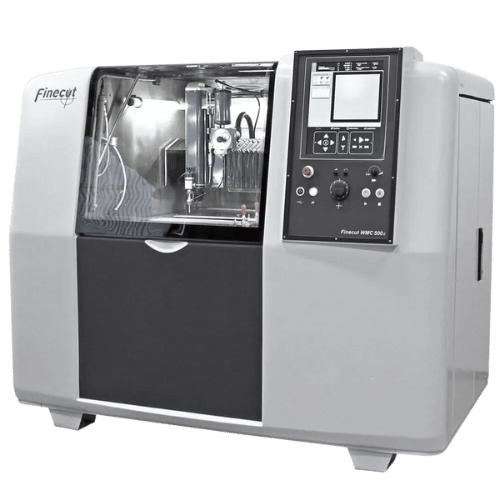
Finecut Series of
Micro Abrasive Waterjets
3 axis, 4 axis, and 5 axis micro waterjet series, the ideal technology for cutting nitinol.
Frequently Asked Questions
Yes, micro abrasive waterjet cutting is ideal for cutting micro shapes like nitinol stents, nitinol tubes, and nitinol plates with high precision and excellent edge and surface quality. Micro waterjet and femtosecond laser are the preferred cutting technologies for cutting nitinol shapes used in the medical industry for medical devices, surgical instruments, and surgical implants.
The most common demonstration of the shape memory effect is that a piece of the alloy can be deformed – for example, by winding a piece of straight wire into a tight coil – and then the deformation can be completely removed by heating the metal a small amount, as by dipping it into hot water. The heat from the water causes a phase change in the nitinol and the metal instantly ‘remembers’ its original shape and returns to the form of a straight wire.
Also called pseudoelasticity, it is a common quality of shape memory alloys like nitinol that allows for exceptional amounts of elongation to occur before the yield stress of the material is reached. When subjected to mechanical stress like tension, metals deform elastically to some degree before being overstrained and starting to deform plastically.
Think of a small spring, such as the one in a click-type pen. When the spring is being used normally, it can be stretched or compressed, but it always tries to return to its normal length. This is elastic deformation behaviour. However, if you stretch the spring by hand past its elastic limit, it will become permanently stretched. This is because the yield stress of the spring’s metal was exceeded, so the spring began to show plastic deformation behaviour. Nitinol can be stretched to 10-30 times as much as ordinary metals before becoming permanently deformed.
While nitinol can be a very strong material, it is generally not as strong as titanium. Generally speaking however, the two materials are used for very different applications. Titanium offers exceptional strength and rigid support, while nitinol deforms more easily and stretches.
This makes titanium more useful for applications that require high rigidity, like aerospace structural components and high-performance sports equipment, while nitinol is more useful for applications that require flexibility, like the orthodontic wire on braces or high-durability glasses frames.